
You’re Not Alone: Beating the January Blues
January’s a heavy time for many expat families in the Netherlands. The holidays are over, the days are short, the weather’s grey, and routines that worked in autumn suddenly take more effort. The statistics bear this out: according to the American Psychiatric Association (APA), 40% of people polled say that their mood declines in winter. For kids and teens adjusting to international school life (and for parents balancing work, family life, and cultural differences), this period can be tough.
At EKC, we see this every year. Parents tell us their kids seem a little more withdrawn or irritable. Teens report feeling flat or unmotivated. Adults notice that even the simplest tasks take more energy than usual. These reactions are common, and they make sense. Winter reduces daylight and social contact often drops. Couple that with the “fresh start” pressure of the new year and it’s easy to understand.
The good news is that there are practical tools that can help. One of them was created by our very own EKC therapist, Jamie Rhiannon Fehribach. It’s based on a well-established therapy approach used for depression: behavioral activation.
So let’s get started. In this installment of our You’re Not Alone series, we’re beating the January blues and taking you with us.
What to Do When You Don’t Feel Like Doing Anything
A common belief about motivation is that we have to “feel better” before we act. We think that motivation should be intrinsic, that if we don’t have it, we can’t start. Unfortunately, this mindset of “waiting for motivation” can keep us frozen. Behavioral activation flips that idea around. Instead of starting with motivation, it starts with action: small, realistic action. Motivation follows over time.
The goal is to get the ball rolling again without overwhelming yourself. This balance is especially important for expat families, where kids and parents are already using a lot of emotional energy to get through the day. Cultural differences, learning a new language, even going about daily life as you adjust can add up to a lot. Behavioral activation doesn’t ask for big lifestyle changes; it asks for honesty: what’s actually possible for you, today?
That’s where Jamie’s Behavioral Activation Tool comes in!
Daily Check-Ins that Lower the Bar
Jamie created a simple monthly check-in sheet that helps kids, teens, and adults reflect on their day. The goal is to touch a few areas that research consistently links to improved mood. Every day, you check whether you’ve done something, even something very small, in each category.
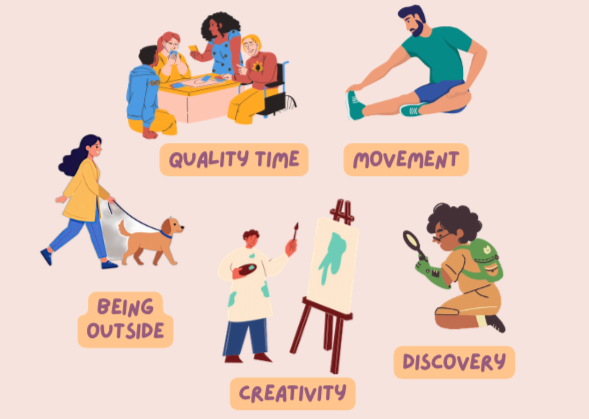
The categories are: Movement, Creation, Quality Time, Discovery, and Being Outside.
What makes this behavioral activation tool effective is its flexibility. “Movement” might be a long walk one day and five minutes of stretching the next. “Being Outside” could mean a bike ride, or it could mean opening a window and taking a couple breaths of fresh air. Both count.
This matters because having a low mood often comes with a bad case of “all-or-nothing” thinking. If a kid believes that exercise only counts if it’s a full sports practice, they might do nothing at all instead. This tool gently challenges that idea. It reminds us that there’s a grey area, where so much is possible.
What Does This Look Like On Harder Days?
So how do we make all of this actionable, especially on hard days? Here are a couple realistic examples to give you ideas:
Let’s say that a primary school child feels tired after school. Checking off their boxes might look like this:
Being Outside happened in the morning, when they walked out of the house and headed to school.
Dancing to a song in their room is a good example of Movement.
Creation could be building with LEGO, or drawing a picture.
They might Discover something while talking with siblings at family dinner.
Spending some Quality Time can be as easy as reading a book with a parent before bed.
Teens can check off their boxes too, even on the tough days:
Walking or riding your bike to school counts as both Movement and Being Outside.
Discovering something can be as simple as watching an informative tiktok, or reading a couple pages of a book.
Maybe Creation means doodling something small, or writing in your journal.
You don’t have to be together in person to spend Quality Time; sending a voice message to a friend is also meaningful.
And last but certainly not least, the adults among us. How can you check off the list?
Creation often happens through work tasks. Maybe you did something you were particularly glad to finish today, or something you’re proud of.
Movement and Being Outside could be a matter of heading to the shops.
Dinner with the family’s a great time to Discover something, through your kids and what they’re studying or what your partner got up to at work.
Spending Quality Time can look like a Netflix evening on the couch with your partner, or just reading a story to your children before bed.
An important note is that it’s totally okay to “double dip.” You can get “movement” at the same time as “being outside.” Theoretically, you could hit all the points at once: take a walk (being outside, movement) with your kids (quality time) and make nature bracelets (creation) while looking up facts about different leaves (discovery). The boxes are there to give you permission to have a little fun, to do something for yourself every day.
And it’s okay if you can’t hit all the boxes every day. The point isn’t to fill them all in perfectly. It’s to notice patterns and support momentum as you get back into the groove—and to help you stay there.
What About Days with More Energy?
Because the check-in is so flexible, it’s a tool that will grow with you as your energy improves. As you find that you have more capacity, checking the boxes might look a little more like this:
Movement could be trying a yoga class, going on a run, or picking up a new fitness hobby, like weightlifting. It can also be playing outside with the kids or going out dancing with friends.
Creation has a huge range of possibilities. You could try something new, like pottery or working on a car or bike. Maybe you want to build something you haven’t built before, either in real life or while playing Minecraft. You can write a poem or story, or draw a card for someone you love. You can put your own spin on a recipe to make something different and delicious. Anything you can make counts!
Spending Quality Time with friends and loved ones is always wonderful. When you have more energy, it can also include getting together in person with someone you don’t see too often, going on a trip, or doing something you’ve always wanted to do together: learning something new, visiting a museum, or planning an adventure.
Discovery is also an area that grows with more time and energy to devote to it. “Discovery” encompasses anything that sparks excitement when you learn about it and joy when you uncover more. As you have more capacity, you can watch full documentaries on a topic, try a class on your own or with someone else (which also counts as quality time!), or read books that pique your interest.
While Being Outside can be as simple as opening a window and taking a deep breath, it can also include walks, runs, hikes, nature exploration, bike rides, and play. With more energy, being outside can go from incidental (heading out the door to work or school to intentional: spending time enjoying the fresh air.
Why This Especially Helps Expat Kids
Expat kids often feel pressure to cope well. They might hear comments like “you’re so adaptable,” or “you’re very mature for your age.” While meant kindly, these messages can make kids feel like they shouldn’t struggle.
That’s the beauty of this tool. It gives kids permission to meet themselves where they are. It also gives families a shared language that isn’t focused on mood alone. Instead of asking “Why are you so down?” you can ask “Did you get any fresh air today?” or “Were you able to spend any quality time with your friends at school?”
It’s all about shifting the focus from “fixing feelings” to supporting daily life in a steady, realistic way.
Keep it Supportive, Not Stressful
It’s important that this check-in doesn’t turn into another demand. If a child misses several boxes in a day, that’s not failure; it’s useful information. It might signal that school’s taking more energy than usual, or that they need a little extra rest.
Some families like to make it a routine to look at their sheets together once a week, instead of daily. Others keep it private and use it as a personal reflection. There’s no single “right” way to use it. And parents can strengthen its impact by modeling the same approach themselves. Saying, “today I couldn’t do much other than work and a short walk, and that’s okay,” shows kids that worth isn’t tied to productivity.
Beating the January Blues doesn’t need big resolutions or dramatic changes. Often, what helps most is consistency paired with compassion. Jamie’s tool offers structure without pressure and action without overload, allowing small steps to make winter feel more manageable. Progress doesn’t have to be loud to be meaningful. Sometimes, moving forward really does start with one small, doable step.
Making a change? Let’s do it together.
Expat Kids Club isn’t just for people who live abroad—it’s for anyone who identifies as a current or former expat and needs support, anywhere in the world. We also offer video consults and appointments so our clients can build a stable, trusting relationship with their therapist, no matter where life takes them.
We specialize in helping people navigate new experiences and situations from the universal to the unique. Our mission is to help kids, teens, and families build resiliency, discover their identities and values, and form healthy coping strategies to manage the tough moments.
EKC recognizes the importance of treating the family as a unit, bringing everyone together. We work with an individual approach and a systemic mindset to determine the best through any challenge.
Schedule a call today to speak with one of our therapists and see how we can help your family thrive.